
No products in the cart.
This material on trustworthiness and social emotional learning is from the teaching guide
for the video “TRUSTWORTHINESS“
in the 10-part DVD series THE SIX PILLARS OF CHARACTER
HOW TO BE
TRUSTWORTHY
BE HONEST. . .
Don’t lie, cheat, or steal.
BE RELIABLE. . .
Keep your promises and follow through on your commitments.
HAVE THE COURAGE. . .
to do what is right, even when it seems difficult.
BE A GOOD FRIEND. . .
and don’t betray a trust.
DISCUSSION QUESTIONS
If you are using the video, ask the first question before viewing.
1. What would you do if a friend of yours gave you an expensive present, but you found out it was stolen?
 Questions to ask after showing Act I
2. Summarize what happened in act one.
3. Why did Muggsy want to give Groark such an expensive present?
4. Was it okay for Muggsy to steal the present if he didn’t have enough money to pay for it? Why, or why not?
5. Is it okay for Groark to keep the present if he is not the one who stole it? Why, or why not?
6. When Groark found out it was stolen, how did he feel about it?
This material is from the teaching guide
for the video “TRUSTWORTHINESS“
in the 10-part DVD series THE SIX PILLARS OF CHARACTER

7. Groark seems to be confused. What is he confused about?
8. What do you think Groark is going do? What do you think he should do?
 Questions to ask after showing Act II
9. What was “the really big important question” that Socrates asked Groark? (see next question)
10. Socrates asks, “if a thing as been stolen, who does it belong to?” Does the gift belong to Muggsy who took it? To Groark who received it? Who does it belong to? Is there anything wrong with accepting a gift if you know it was stolen?
11. Socrates tells Groark , “just do what’s right.” What do you think is the right thing to do? Is it always easy to do what’s right?
12. Groark says that giving back the gift will be hard. Why? What is he concerned about? (Muggsy’s feelings)
13. Diotima tells Groark that he will be doing Muggsy a favor by telling him how he really feels about the stolen gift. How would that be a favor? How do you think it will make Muggsy feel?
14. Diotima tells Groark that all good friendships are based on what? (honesty and trust) Do you think that’s true? Why, or why not?
15. Imagine that you are Groark. How could you tell Muggsy you don’t want the gift without hurting his feelings?
16. What did Groark learn from Socrates? From Diotima?
 Questions to ask after showing Act III
17. How do you feel about the way Groark handled things with Muggsy? Why? What could he have done better?
18. Did Groark harm his friendship with Muggsy by telling him the truth? Did he make it better? How?
19. Why didn’t Groark want Muggsy to lie to the store owner about how he got the space station? (That would make him a liar.)
20. What is wrong with lying? Do you trust people who lie? Do you care if your friends lie?
21. What kind of friend did Groark tell Muggsy he wants him to be? (A friend he can trust.)
22. How do you think Groark felt about himself at the end of the video? Was he still confused? What did he learn from the experience?
General Questions about Trustworthiness
23. How do you feel when someone tells you a lie?
24. Do you think that lying can ruin a friendship? Explain. Has that ever happened to you?
25. If you tell just one lie, does that make you a liar? How many lies do you get to tell before you are a liar?
26. Would you trust somebody who lies? Who cheats? Who steals? Why, or why not?
27. How do you know if you can trust someone?
28. Do you consider yourself to be an honest person? Why?
29. What does trustworthiness mean to you? What is a trustworthy person?
30. Do you consider yourself a trustworthy person? In what way are you a trustworthy person?
31. Do your parents trust you? What could you do that would make your parents stop trusting you? What would be bad about that?
32. It’s been said that cheating is just another form of lying. Do you agree?
33. Describe a time when you lied, cheated, or stole something. What happened? How did you feel? What were the consequences?
34. How can simply being honest make life a lot easier. Have you ever experienced this in your own life?
35. How important is trust in your relationships with friends and family? How would these relationships be affected if you found out someone was lying to you?
36. What does trust have to do with honesty?
(If you wish to copy or use any material from this website, please click here for Terms of Use.)
 |
To find teaching guides on Trustworthiness and related topics for other grade levels |
 |
STUDENT ACTIVITIES
1. The top of this page (How to be Trustworthy) gives four specific trustworthiness behaviors. Write these behaviors on the board. Have the children think of as many examples of each behavior as they can, and write them on the board. Can they think of any other trustworthiness behaviors that should be added to the list? Have a class discussion about these behaviors. Have the children make posters of these behaviors to put up around the school.
2. Have the students keep an “Honesty-Dishonesty” journal for one week. In this journal, document examples of honesty and dishonesty in everyday life. Keep track of all the times you hear or tell “white lies.” Pay particular attention to television. Note how often dishonesty is basic to the plot of TV sitcoms and dramas. At the end of a week, write your conclusions and share them with the class. What did you learn about your own behavior from doing this project?
 3. As a class, brainstorm all the excuses and rationalizations people give for lying, cheating, and stealing, and then have a discussion about them. How valid are they? What’s wrong with each of them?
4. Conduct a survey in your school or community asking questions like the following: Do you think people are honest enough? What are some examples of dishonesty you really dislike? What are some examples of honesty that you especially appreciate? Compile the results into a scrapbook.
5. Role-play or use puppets to act out various situations where one or more students are under pressure to be dishonest. Example: lying to cover up for a friend. Put it on videotape and share it with other classes.
(If you wish to copy or use any material from this website, please click here for Terms of Use.)
Other teaching guides in this series:
 |
• Trustworthiness • Respect • Responsibility |
• Fairness • Caring • Citizenship |
 |
This material is from the teaching guide
for the video “TRUSTWORTHINESS“
in the 10-part DVD series THE SIX PILLARS OF CHARACTER
WRITING ASSIGNMENTS
1. How trustworthy are you? For each of the four trustworthy behaviors listed at the top of this page, rate yourself on a scale of one to five (1=awful, and 5=terrific). For each of these behaviors give an example of how you are either trustworthy or not, and what you could do to improve.
2. Write an essay about a situation in which you were dishonest (lied, cheated, or stole). Why did it happen? How did you justify it? How did you feel about it at the time? Did it affect any of your relationships? Did it cause any problems for you? How do you feel about it now? What did you learn from it?
 3. If your children are old enough to write book reports, have them write about how the charac-ters in the book behaved in either a trustworthy or an untrustworthy way. Do the same with movies or television programs they have seen. If your children are too young to write book reports, do this as a class discussion about the books they are reading or that you are reading to them.
4. Write about someone you trust. Why do you trust that person?
5. Write about how it makes you feel when somebody lies to you or misleads you.
6. Write about a time somebody broke a promise to you. How did that make you feel? Have you ever broken a promise to someone? How do you think it made that person feel?
(If you wish to copy or use any material from this website, please click here for Terms of Use.)
(Copy this block and send it home to the parents.)
FOR PARENTS
Dear Parent,
Your child has just viewed a video entitled The Six Pillars of Character: TRUSTWORTHINESS which shows how honesty, integrity, and other aspects of being a trustworthy person lead to good friendships and positive interpersonal relationships.
Here are some things you can do to reinforce the message of this video and our related learning activities.
• Ask your child to tell you about the video program and what he or she learned from it. • Talk with your child about what it means to be an honest and trustworthy person and why it is important. Make sure he/she knows that it is important to you.
• Watch a television program together, and talk about the various ways in which the characters acted dishonestly towards one another..
• Remember, you are your child’s most important teacher. He or she will learn a lot about being trustworthy from watching what you do.
This material is from the teaching guide
for the video “TRUSTWORTHINESS“
in the 10-part DVD series THE SIX PILLARS OF CHARACTER
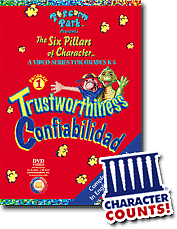
TRUSTWORTHINESS
the video
the video
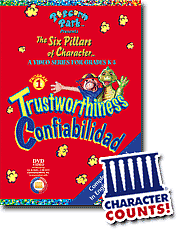
This video teaches children:
• That it is important to be honest, trustworthy people.
• That lying and stealing are wrong.
• That trust is essential for good relationships.
• Both English and Spanish on same DVD.
• Closed Captioned for the Hearing Impaired.
Click play for a sampling of
“Six Pillars of Character “
“Six Pillars of Character “
“THE SIX PILLARS OF CHARACTER”
the series
the series
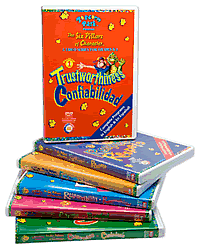

Help your kids explore six essential character virtues with the Popcorn Park Puppets. In each video the puppets become entangled in problems that require them to sort out right from wrong. more. . .
For more information about individual videos in this series, click on the title below.
• Trustworthiness
• Respect
• Responsibility
• Fairness
• Caring
• Citizenship
If your school or organization does not have these videos, you can purchase them from Live Wire Media, or request them from your local library.
Subscribe to our almost
Monthly Newsletter
Get breaking news and developments in character education and helpful tips and ideas that you can use with your own character education program.
View the current issue.

 Wouldn’t this poster or banner look good in your classroom? Click Here!
Meet the

Puppets

Nubbs, Burna, Muggsy, Essie, Groark