
No products in the cart.
This material is from the teaching guide
for the video “RESOLVING CONFLICTS“
in the 10-part DVD series You Can Choose!
HOW TO RESOLVE CONFLICTS
Without Fighting
STEPS:
1. STOP. Don’t let the conflict get worse. The less angry you are the easier it will be to solve the problem.
2. SAY what the conflict is about. What is causing the disagreement? What does each of you want or not want?
3. THINK of positive options. How could you meet each other’s needs and be fair?
4. CHOOSE a positive option each of you can agree on.
If you still can’t agree, ask someone else (an outsider) to help resolve the conflict.
RULES:
 Agree to resolve the conflict.
 No name calling.
 Take turns talking. Don’t interrupt.
 Be clear and truthful about what is bothering you and what you really need.
 Listen to the other person. Be sure you understand how he or she sees the problem.
 Use your brains, not your hands.
Be willing to compromise (if that’s appropriate).
(If you wish to copy or use any material from this website, please click here for Terms of Use.)
DISCUSSION QUESTIONS
If you are using the video, ask the first two questions before viewing.
1. Have you ever seen a small disagreement turn into a big fight. What do you think made that happen?
 2. Have you ever found yourself caught in the middle when other people couldn’t agree? How did you feel? What did you say or do?
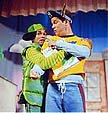
3. Why did Rhonda and Tuggy get so angry? How could it have been prevented?
4. How did the argument get out of control? What could Rhonda and Tuggy have done to keep the argument from getting out of control?
5. Who do you think was to blame? Why?
6. What happens when people who are disagreeing don’t listen to each other? What can they do about it?
This material is from the teaching guide
for the video “RESOLVING CONFLICTS“
in the 10-part DVD series You Can Choose!

7. How do you think Missie was feeling?
8. What would you like to say to Rhonda and Tuggy?
 9. At the end of the video, Tuggy says that when people are fighting, it’s like they’re in two different worlds. What did he mean by that?
10. What does the word “compromise” mean? How does it work? What has to happen before people can compromise?
11. Why is it important to settle disputes peacefully? What can happen if you don’t?
12. Are there some conflicts that can’t be resolved?
(If you wish to copy or use any material from this website, please click here for Terms of Use.)
 |
To find additional teaching guides on this and other topics |
 |
1. Hand out copies of the STEPS and RULES for resolving conflicts that are in the block at the top of this column (or write them on the board). Discuss each step and rule with the children.
 2. Ask the children to describe a variety of conflicts that commonly occur at school. List these on the board. For two or three of them, discuss how the steps and rules of conflict resolution could be used. Then have pairs or small groups apply the steps and rules to the other situations listed on the board. Afterward, have a class discussion to compare results.
3. Introduce the concept of “I-messages” and “blaming” messages. Tell the students an “I-message” is a statement about your own feelings. It says what’s bothering you and why.
Example: “It really bothers me that we can’t find a way to compromise. We could do a better job if we worked together instead of arguing all the time.”
A “blaming” message says what’s wrong with the other person.
Example: “You’re ruining our project. You’re a jerk. You never do anything right.”
An “I-message” is constructive and points to a solution. A “blaming” message puts the other person on the defensive and leads to more conflict. “I-messages” usually work better.
Referring to the conflicts already listed on the board, ask students to role play using “I-messages” in these situations instead of “blaming” messages. You might want to demonstrate the “blaming” messages yourself to avoid asking students to practice a negative behavior.
(If you wish to copy or use any material from this website, please click here for Terms of Use.)
Other teaching guides in this series:
 |
• Cooperation • Being Responsible • Dealing with Feelings • Saying No • Doing the Right Thing |
• Disappointment • Appreciating Yourself • Asking for Help • Being Friends • Resolving Conflicts |
 |
This material is from the teaching guide
for the video “RESOLVING CONFLICTS“
in the 10-part DVD series You Can Choose!
WRITING ASSIGNMENTS
1. Write about a time when you or someone you know got into a conflict that wasn’t resolved. Describe how the steps and rules of conflict resolution could have been used to resolve it.
2. Write a short story about a conflict. Make up two endings. In one ending the conflict is resolved, and in the other it isn’t.
 3. Make a list of things you could say or do to keep cool during a conflict.
4. Note to the teacher: You can spark students’ thinking for this assignment by giving examples of several typical conflicts between people their age. Divide a sheet of paper in half lengthwise. Think of a conflict or disagreement. On one side write “blaming” messages for that situation. On the other side write “why” messages that could be used instead.
(If you wish to copy or use any material from this website, please click here for Terms of Use.)
To enlist the involvement of parents, make copies of the “For Parents” block (see below) and send them home with the children. Tell the children to discuss the video with their parents, and to perform the following activities.
1. List the steps and rules of conflict resolution (see “How to Resolve Conflicts” at the top of this column) on a sheet of paper and post them at home so family members can learn and practice them.
 2. Ask family members or neighbors to describe conflicts they’ve experienced. Discuss how the steps and rules of conflict resolution could have helped.
3. When someone uses a “blaming” message in a conflict with you, ask that person to use an “I-message” instead. Explain the benefits of using “I-messages” instead of “blaming” messages. Also, try not to use “blaming” messages yourself.
Note to the teacher or group leader: It might be a good idea to think of some way for the children to share the outcomes of these activities with each other. Perhaps they could give written or oral reports or discuss their experiences in small groups.
(If you wish to copy or use any material from this website, please click here for Terms of Use.)
(Copy this block and send it home to the parents.)
FOR PARENTS
Dear Parent,
Your child is involved in learning-activities designed to develop good character and empower young people to make good choices for themselves. He or she may be asked to complete several tasks at home. Your cooperation with these activities will support our overall program.
The current lesson is about conflict resolution. We have shown a video entitled “Resolving Conflicts,” which presents a skit and discussion about two kids who learn how to settle their differences peacefully. We urge you to ask your child to tell you about this video program and what he or she learned from it.
Here are some things you can do to help your child learn how to settle disputes peacefully and constructively.
• Ask your child to explain the steps and rules of conflict resolution he or she has learned at school. Post them in a place where everyone can refer to them. Use the steps in resolving family conflicts.
• If your child has a conflict with a sibling or friend, call “time out” so they can cool off. Then go through the steps of conflict resolution with them and remind them of the rules.
• Ask your child to explain the difference between “I-messages” and “blaming” messages. Try to use “I-messages” as often as possible and avoid “blaming” messages.
This material is from the teaching guide
for the video “RESOLVING CONFLICTS“
in the 10-part DVD series You Can Choose!
“RESOLVING CONFLICTS”
the video
the video
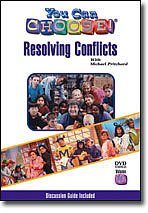
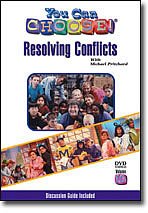
This video teaches children ways to work out interpersonal conflicts without fighting.
“YOU CAN CHOOSE!”
the series
the series
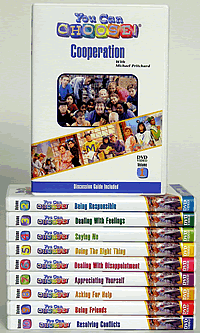

Start your kids on the path to positive, healthful life choices. This delightful video series teaches children valuable lessons that contribute to self-discipline, good decision-making, high self-esteem, a sense of responsibility, and the ability to get along with others. more. . .
For more information about individual videos in this series, click on the title below.
• Cooperation
• Being Responsible
• Dealing with Feelings
• Saying No
• Doing the Right Thing
• Disappointment
• Appreciating Yourself
• Asking for Help
• Being Friends
• Resolving Conflicts
If your school or organization does not have these videos, you can purchase them from Live Wire Media, or request them from your local library.
Subscribe to our almost
Monthly Newsletter
Get breaking news and developments in character education and helpful tips and ideas that you can use with your own character education program.
View the current issue.
