
No products in the cart.
This material is from the teaching guide
for the video “DOING the RIGHT THING“
in the 10-part DVD series You Can Choose!
HOW TO DECIDE
WHAT’S THE RIGHT THING TO DO
Some decisions you make aren’t terribly important. For example, you might decide to have chocolate ice cream instead of vanilla. But other decisions may involve a choice between right and wrong, and sometimes it’s not easy to know what to do. Whenever you aren’t sure what’s the right thing to do, stop and think! Ask yourself these questions:
 What does my conscience—that “little voice” inside my head—say about it?
 Could it hurt anyone—including me?
 Is it fair?
 Would it violate the Golden Rule? (How would I feel if somebody did it to me?)
 Have I ever been told that it’s wrong?
 Deep down how do I feel about it?
How will I feel about myself later if I do it?
What would adults I respect say about it?
If you still can’t decide, talk it over with someone you trust and respect.
(If you wish to copy or use any material from this website, please click here for Terms of Use.)
DISCUSSION QUESTIONS
If you are using the video, ask the first three questions before viewing.
1. Have you ever found something that belonged to someone else and wanted to keep it? What did you do and how did you decide?
 2. What’s wrong with “finders keepers, losers weepers”?
3. Have you ever heard of the Golden Rule? Who can recite it and say what it means?
4. Did Rhonda and Fiona know the right thing to do when they found the wallet?
5. What made Rhonda and Fiona change their minds about keeping the money?
6. Do you think things would have turned out differently if Tuggy hadn’t appeared? Explain.
This material is from the teaching guide
for the video “DOING the RIGHT THING“
in the 10-part DVD series You Can Choose!

7. Have you ever really wanted to do something, but deep down you felt it wasn’t right? How did you decide what to do?
8. How often do you think about whether something is right or wrong before you decide to do it?
 9. Why do people sometimes do the right thing even when it’s not as easy or as much fun as something else?
10. When you’re faced with a choice between right and wrong, what influences your decision?
11. What would happen if nobody cared about doing the right thing?
12. How do you know when something you might do is right or wrong?
(If you wish to copy or use any material from this website, please click here for Terms of Use.)
 |
To find teaching guides on related topics for this and other grade levels |
 |
1. Have the class brainstorm ways to tell whether or not something is the right thing to do. List their ideas on the board. Compare their list with the one on the opposite page.
2. Divide the class into small groups. Give each group one of the following situations to role play. In each role play half the group wants to do the wrong thing and the other half wants to do the right thing. Each half tries to give strong reasons for their side. Discuss the results in class.
Situations:
— You pass an empty old house. In front of it there’s a “No Trespassing” sign. But the front door is open. You really want to go in and see what’s there. No one is around. What do you do?
— A group of kids who you think are really cool are picking on another kid. They want you to join them, and they say you’re a nerd if you don’t. You don’t want to be left out, but you think picking on the other kid is unfair. What do you do?
— You’re walking home from school, and you’re really hungry because you forgot to bring your lunch that day. You pass by a fruit stand, and the fruit looks so good you can almost taste it. “They’ll never miss just one apple,” you think to yourself. And no one is looking. What do you do?
— Your best friend asks you to help him cheat on a test. He’s never done it before and he promises he’ll never do it again. What do you do?
 3. Encourage the children to make up their own situations, and continue the role plays.
(If you wish to copy or use any material from this website, please click here for Terms of Use.)
Other teaching guides in this series:
 |
• Cooperation • Being Responsible • Dealing with Feelings • Saying No • Doing the Right Thing |
• Disappointment • Appreciating Yourself • Asking for Help • Being Friends • Resolving Conflicts |
 |
This material is from the teaching guide
for the video “DOING the RIGHT THING“
in the 10-part DVD series You Can Choose!
WRITING ASSIGNMENTS
1. Pretend you’re giving a speech on the topic “It’s never okay to do the wrong thing.” Write at least four reasons to back up the statement for your speech.
2. Write about a time when someone tried to get you to do something wrong. What did you say or do? How did you know whether it was right or wrong?
3. Write about someone you admire for doing the right thing in a difficult situation. Describe what you admire about this person.
 4. Write at least five things you can say to yourself when you’re tempted to do something wrong. Post them near your bed so you can read them from time to time.
5. Write a short story about someone who did the right thing when friends wanted him or her to do the opposite.
6. Write about a time when someone helped you do the right thing. Or: write a letter to that person thanking him or her for helping you.
7. Write a letter to someone in the news who did something that you don’t think was right. Say why you don’t think it was right, and why you think the person is setting a bad example for kids your age. Mail the letter.
(If you wish to copy or use any material from this website, please click here for Terms of Use.)
To enlist the involvement of parents, make copies of the “For Parents” block (see below) and send them home with the children. Tell the children to discuss the video with their parents, and to perform the following activities.
1. Take home your list of ways to decide what’s the right thing to do (see the top block in this column). Discuss it with your parents or other adult family members. Ask them if they have anything to add.
 2. Watch a television program with your family. Afterward, have a family discussion about the way characters in the program behaved. Can you find examples of characters either doing the right thing or not doing the right thing? What should any of the characters have done differently? Why?
3. For a week keep a daily record of choices you make that involve deciding between right and wrong. How do you feel about the choices you made? How could you do better?
4. Ask family members to tell you about a time when either they did the right thing and are really glad they did, or didn’t do the right thing and are sorry about it. What would have resulted if they had made the opposite choice?
Note to the teacher or group leader: It might be a good idea to think of some way for the children to share the outcomes of these activities with each other. Perhaps they could give written or oral reports or discuss their experiences in small groups.
(If you wish to copy or use any material from this website, please click here for Terms of Use.)
(Copy this block and send it home to the parents.)
FOR PARENTS
Dear Parent,
Your child is involved in learning-activities designed to develop good character and empower young people to make good choices for themselves. He or she may be asked to complete several tasks at home. Your cooperation with these activities will support our overall program.
The current lesson is about the importance of always doing what’s right. We have shown a video entitled Doing the Right Thing, which presents a skit and discussion about two people trying to decide whether or not to turn in a lost wallet. We urge you to ask your child to tell you about this video program and what he or she learned from it.
Here are some things you can do to encourage your child to always try to do what’s right.
• Start with your own example. If you always base your own decisions on what you believe is right, that will mean more to your child than hours of lecturing.
• Take time to talk about issues of right and wrong with your child.
• When you watch TV or movies with your child, look critically at the way the characters behave and have a discussion about it.
• Be sensitive to what your child says about decisions involving right or wrong. Don’t hesitate to correct statements like, “It doesn’t matter—nobody will ever find out” or “Everybody does it.”
• Encourage your child to think about whether something is right or wrong before acting.
This material is from the teaching guide
for the video “DOING the RIGHT THING“
in the 10-part DVD series You Can Choose!
“DOING the
RIGHT THING”
the video
RIGHT THING”
the video
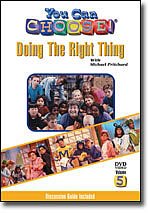
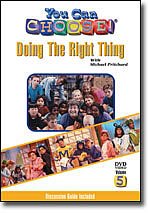
This video teaches children:
• To think about whether something is right or wrong before making a choice.
• Guidelines for deciding what’s the right thing to do.
• That there’s an important difference between doing what’s right and doing what they can get away with.
“YOU CAN CHOOSE!”
the series
the series


Start your kids on the path to positive, healthful life choices. This delightful video series teaches children valuable lessons that contribute to self-discipline, good decision-making, high self-esteem, a sense of responsibility, and the ability to get along with others. more. . .
For more information about individual videos in this series, click on the title below.
• Cooperation
• Being Responsible
• Dealing with Feelings
• Saying No
• Doing the Right Thing
• Disappointment
• Appreciating Yourself
• Asking for Help
• Being Friends
• Resolving Conflicts
If your school or organization does not have these videos, you can purchase them from Live Wire Media, or request them from your local library.
Subscribe to our almost
Monthly Newsletter
Get breaking news and developments in character education and helpful tips and ideas that you can use with your own character education program.
View the current issue.
