
No products in the cart.
This material is from the teaching guide
for the video “COOPERATION“
in the 10-part DVD series You Can Choose!
HOW TO BE
A COOPERATIVE PERSON
 LISTEN carefully to others and be sure you understand what they are saying.
 SHARE when you have something that others would like to have.
 TAKE TURNS when there is something that nobody wants to do, or when more than one person wants to do the same thing.
 COMPROMISE when you have a serious conflict.
 DO YOUR PART the very best that you possibly can. This will inspire others to do the same.
 SHOW APPRECIATION to people for what they contribute.
ENCOURAGE PEOPLE to do their best.
MAKE PEOPLE FEEL NEEDED. Working together is a lot more fun that way.
DON’T ISOLATE OR EXCLUDE ANYONE. Everybody has something valuable to offer, and nobody likes being left out.
(If you wish to copy or use any material from this website, please click here for Terms of Use.)
DISCUSSION QUESTIONS
If you are using the video, ask the first three questions before viewing.
1. What makes working in groups fun? What can make it not fun?
 2. What does the word “cooperate” mean?
3. Can you name some things you do at school that require cooperating? At home?
4. Why did Moose have so much difficulty cooperating with his friends?
5. How do you think Moose felt about himself for quitting his group? How do you think it made Moose’s friends feel about him?
6. Why do you think Moose changed his mind?
This material is from the teaching guide
for the video “COOPERATION“
in the 10-part DVD series You Can Choose!
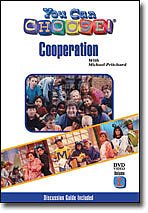

7. What did Moose’s friends do to make it easy for him to cooperate? How could they have made it difficult?
8. The kids in the discussion part of the program talked about many of the things you can do to be a cooperative person. How many can you name? (See the list of cooperative behaviors at the top of this column.) Can you think of any they left out?
9. What makes you feel like an important part of a group?
 10. What is the difference between cooperating and just going along with the group?
11. Did the kids in the discussion part of the program say anything that you strongly agree or disagree with?
12. What did you learn from this video?
(If you wish to copy or use any material from this website, please click here for Terms of Use.)
 |
To find teaching guides on other topics for this and other grade levels |
 |
1. Break the kids into four groups and tell them they’re going to make music. One group claps, one group whistles, one group taps on their seats, one group makes shushing sounds with their mouths (like cymbals). Each group plays their sound when you point to them. The object is for each group to get itself coordinated into something that sounds good without talking to the other member(s) of the group. In order to accomplish this they have to listen to what each other is doing and adjust accordingly. Point to the groups one at a time, letting each group get their act together. Then, start adding the groups together allowing time for them to adjust what they’re doing until they start to sound good. Eventually, you’ll have all the groups going at once in a well  coordinated ensemble.
When the concert is over, ask the kids what made this activity fun and why it required cooperation to make it work. What would have made it work better? If it didn’t work, why not?
2. Break the class or group into small teams (five children per team is a good number). Their assignment is to invent a new animal. They must name it, draw it, and decide how and where it lives. Afterward, have each team present its animal to the class and tell exactly how they worked together to create it.
3. Design a “How to Cooperate” poster that illustrates the cooperative behaviors listed at the top of this column. Keep it displayed on a wall.
4. What’s good about cooperating? Make a list of all the benefits.
(If you wish to copy or use any material from this website, please click here for Terms of Use.)
Other teaching guides in this series:
 |
• Cooperation • Being Responsible • Dealing with Feelings • Saying No • Doing the Right Thing |
• Disappointment • Appreciating Yourself • Asking for Help • Being Friends • Resolving Conflicts |
 |
This material is from the teaching guide
for the video “COOPERATION“
in the 10-part DVD series You Can Choose!
WRITING ASSIGNMENTS
1. Think of a really good experience you had as a member of a group. What made it good? Think of a bad experience. What made it bad? What can you learn from the comparison?
2. Are you a cooperative person? For each of the cooperative behaviors listed at the top of this column, rate yourself on a scale of one to five (1=awful, and 5=terrific). For each of these behaviors give an example of how you are either good at it or not so good at it, and what you could do to improve.
3. Describe a time you had difficulty cooperating. What made it difficult? What did you do about it? Is there something you could have done that would have made it easier?
 4. Imagine that you get out of bed one morning in a rotten mood and you feel like being totally uncooperative for the whole day. Write about all the things you could do that would make your friends and teachers look at you and say, “Boy, are you being uncooperative today!”
5. Think of a time somebody (a friend, classmate, family member, etc.) was very uncooperative with you. Write a pretend letter to that person describing what he or she did, how it made you feel, and what you want this person to do differently in the future.
6. Write about a problem in the world that might be solved if people would cooperate more. Why aren’t they cooperating now? How could they do a better job of cooperating?
(If you wish to copy or use any material from this website, please click here for Terms of Use.)
To enlist the involvement of parents, make copies of the “For Parents” block (see below) and send them home with the children. Tell the children to discuss the video with their parents, and to perform the following activities.
1. Have a discussion about cooperation in the family. In what ways do you cooperate with each other, and how does that make things nice? In what ways do you not cooperate enough, and how does that make things difficult or unpleasant? Make a “family cooperation” chart and see if you can do something about improving the cooperation within the family.
 2. For one week keep a daily record of all the things you do that require cooperation (at home, at school, and everywhere else). At the end of the week give yourself a grade on how cooperative you have been.
3. Pick one television program and watch it with your family. Afterward, have a family discussion about things people did in the program that were examples of either good or bad cooperation. Make a list of these examples.
Note to the teacher or group leader: It might be a good idea to think of some way for the children to share the outcomes of these activities with each other. Perhaps they could give written or oral reports or discuss their experiences in small groups.
(If you wish to copy or use any material from this website, please click here for Terms of Use.)
(Copy this block and send it home to the parents.)
FOR PARENTS
Dear Parent,
Your child is involved in learning-activities designed to develop good character and empower young people to make good choices for themselves. He or she may be asked to complete several tasks at home. Your cooperation with these activities will support our overall program.
The current lesson is about the importance of cooperating with friends and classmates. We have shown a video entitled, Cooperation, which presents a skit and discussion about the problems that arise when one member of a singing group insists on having everything his way.
Ask your child to tell you about the video program and what he or she learned from it.
Here are some things you can do to support the idea that cooperation is an important life skill and that the rewards outweigh the sacrifices.
• Schedule household chores at a time when all members of the family can work together to finish them.
• Initiate a fun project that involves all family members (a garden, jigsaw puzzle, homemade pizza, etc.).
• “Catch” your child cooperating (or attempting to cooperate) and offer your encouragement by verbally showing your appreciation; material rewards are not necessary.
This material is from the teaching guide
for the video “COOPERATION“
in the 10-part DVD series You Can Choose!
“COOPERATION”
the video
the video
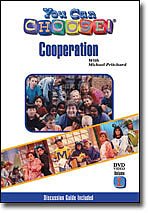
This video teaches children:
• that cooperation is a basic life skill that helps us work successfully in groups and interact harmoniously with others.
• the benefits of being a cooperative person.
• how cooperative people behave toward each other.
“YOU CAN CHOOSE!”
the series
the series
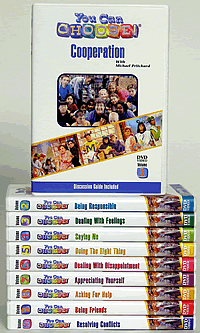

Start your kids on the path to positive, healthful life choices. This delightful video series teaches children valuable lessons that contribute to self-discipline, good decision-making, high self-esteem, a sense of responsibility, and the ability to get along with others. more. . .
For more information about individual videos in this series, click on the title below.
• Cooperation
• Being Responsible
• Dealing with Feelings
• Saying No
• Doing the Right Thing
• Disappointment
• Appreciating Yourself
• Asking for Help
• Being Friends
• Resolving Conflicts
If your school or organization does not have these videos, you can purchase them from Live Wire Media, or request them from your local library.
Subscribe to our almost
Monthly Newsletter
Get breaking news and developments in character education and helpful tips and ideas that you can use with your own character education program.
View the current issue.
