
No products in the cart.
This material is from the teaching guide
for the video “Trustworthiness“
in the 10-part DVD series In Search of Character
Are You a Trustworthy Person?
(Take this self-evaluation and decide for yourself.)
| True | False | |
 |
|
I keep my promises; I am a person of my word. |
|
|
I am reliable; I follow through on commitments. |
|
|
I am honest |
|
|
I keep secrets; I never betray a confidence or a trust. |
|
|
I have integrity; I don’t cave in to temptation. |
|
|
I am loyal when loyalty is appropriate. |
| I think I am/am not a trustworthy person because: ___________________ | ||
(If you wish to copy or use any material from this website, please click here for Terms of Use.)
DISCUSSION QUESTIONS
If you are using the video, ask question 1 before viewing.
1. How do you know when you can trust someone?
2. Some adults say that your generation cannot be trusted, that you’ve lost the values from past generations. Do you agree, or disagree?
3. Is it a good idea to risk losing your parents’ trust for temporary pleasure? In the video Clarence said “So what if you’re in trouble for a little while?” Do you agree or disagree with Clarence’s position?
4. How important is trust in your relationships with friends and family? How would these relationships be affected if you found out someone was lying to you?
5. Once trust has been broken, what can you do to get it back? Have you ever lost someone’s trust? Has someone lost your trust? Explain.
6. If your friends were here right now, would they say you were trustworthy? What would your parents say? Are you more trustworthy with your friends or with your parents? Do you think your parents should trust you automatically? Why or why not?
This material is from the teaching guide
for the video “Trustworthiness“
in the 10-part DVD series In Search of Character

7. The kids in the video identified several aspects of trustworthiness. What were they? Do you agree with them? Can you add any? What does trustworthiness mean to you?
8. If you want someone to trust you, who has most of the responsibility— you or the other person? Why?
9. Dr. Mike said that your trustworthiness may be questioned but your choices will never lie. What does that mean? Do you agree?
10. As a general policy, should we start off trusting people and only stop trusting if they prove that they’re not worthy? Or should we be cautious and not trust them until they prove themselves worthy? What are the advantages and disadvantages of each position?
11. How did Rosa’s story (the peer counselor) make you feel? What did you learn from it?
12. Rosa said, “Trust is the basis for every relationship.” Do you think that’s true? Explain.
13. Rosa said that your willingness to trust another person is important if you want that person to trust you. Do you agree? Explain.
14. Why did the Peer Resource Program at Rosa’s school use a ropes course to train peer counselors?
15. What does being trustworthy have to do with the quality of your character?
16. What are the benefits of being a trustworthy person? How do you benefit from the trustworthiness of others?
17. Did the video present any ideas you disagree with?
(If you wish to copy or use any material from this website, please click here for Terms of Use.)
|
|
To find elementary and middle school teaching guides on Trustworthiness and related topics
click here. |
 |

WRITING ASSIGNMENTS
1. Are you a trustworthy person? In what ways are you trustworthy? In what ways are you, perhaps, not so trustworthy? What could you do to improve?
2. Write an essay describing what this society might be like if nobody were trustworthy, if suspicion, dishonesty, and betrayal were the norm, if nobody could be counted on to keep commitments.
3. Write about someone you trust. Why do you trust that person? How important is that trust to you? How do you reciprocate?
4. If your school doesn’t have a peer counseling program, find out what peer counselors do, and then write an essay or an editorial for your school newspaper advocating that your school start such a program. If your school does have a peer counseling program, write a short article describing the program and its benefits to the school community.
5. Keep a journal for a month that focuses on your relationships with your friends and family in the area of trustworthiness. If there are things that displease you, develop some ideas for improving the situation.
6. Write about a time you lost somebody’s trust or somebody lost your trust. Was this trust ever regained? How? What did you learn from the experience?
(If you wish to copy or use any material from this website, please click here for Terms of Use.)
Other teaching guides in this series:
 |
• Trustworthiness • Respect • Responsibility • Fairness • Caring |
• Citizenship • Honesty • Courage • Diligence • Integrity |
 |
This material is from the teaching guide
for the video “Trustworthiness“
in the 10-part DVD series In Search of Character
STUDENT ACTIVITIES
1. Many people complain that political leaders cannot be trusted. Develop a checklist for evaluating the trustworthiness of political leaders. Test out your checklist by listening to a politician speaking on TV. You can see entire speeches on C-SPAN.
2. Divide the class into small groups. Have each group develop a list of do’s and don’ts for being a trustworthy person. (See our list at the top of this column, or look on page 5 of the video discussion guide.) Have them make oral reports to the class addressing the following questions: What happens when people live in accordance with these guidelines? What happens when they don’t? In what ways does trustworthy and untrustworthy behavior affect our community and society? In what ways can/do young people demonstrate trustworthiness?
3. Have the students watch a movie, TV drama or sitcom, paying particular attention to the behavior of the main characters with regard to trustworthiness. How much trustworthy behavior did they find? How much untrustworthy behavior? Have a class discussion about these issues. (A great many TV plots are based on a deceit.)
4. Most people consider loyalty to be an important part of trustworthiness. What, exactly, is loyalty? Who should be loyal to whom or what, and under what circumstances? When is loyalty appropriate, and when might it be a bad thing? Give some specific examples. Break the class into small groups to ponder these issues and have each group give an oral report to the class.
(If you wish to copy or use any material from this website, please click here for Terms of Use.)
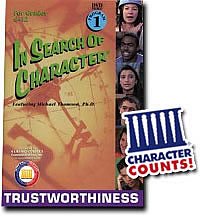
“Trustworthiness” – The Video
Trust is the basis of all good relationships and a cornerstone of good character. This program shows what it means to be a person others can trust. Learn more . . .

Click play for a sampling of
“In Search of Character”
“In Search of Character”
The Series
The Series
This award winning video series spotlights ten core virtues that help teens develop into caring, respectful, responsible people who make choices based on what’s right, rather than what they can get away with.
Learn more . . .
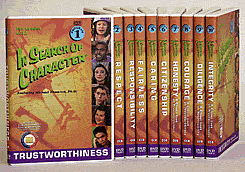

For more information about individual videos in this series, click on the title below.
• Trustworthiness
• Respect
• Responsibility
• Fairness
• Caring
• Citizenship
• Honesty
• Courage
• Diligence
• Integrity
• Respect
• Responsibility
• Fairness
• Caring
• Citizenship
• Honesty
• Courage
• Diligence
• Integrity
If your school or organization does not have these videos, you can purchase them from Live Wire Media, or request them from your local library.

Subscribe to our almost
Monthly Newsletter
Get breaking news and developments in character education and helpful tips and ideas that you can use with your own character education program.
View this month’s newsletter.
