
No products in the cart.
This material is from the teaching guide
for the video “Courage“
in the 10-part DVD series In Search of Character
Are You a Person of Courage?
(Take this self-evaluation and decide for yourself.)
| True | False | |
 |
|
I stand up for what is right even if I stand alone. |
|
|
I don’t cave in to negative peer pressure. |
|
|
Fear of failure does not prevent me from trying things. |
|
|
I am not afraid to express myself just because some people might disapprove. |
|
|
I work to solve problems without violence. |
|
|
I never intentionally ridicule, embarrass, or hurt others. |
| I think I am / am not a courageous person because: ___________________ | ||
“We must build dikes of courage to hold back the flood of fear.”
– Martin Luther King, Jr.
(If you wish to copy or use any material from this website, please click here for Terms of Use.)
DISCUSSION QUESTIONS
If you are using the video, ask questions 1&2 before viewing.
1. Thomas Jefferson said that one person with courage is a majority. What does that mean to you?
2. What is courage?
3. How did Arturo’s story (in the video) make you feel? What did you learn from it? What were some of the pressures Arturo encountered and how did he overcome them? What risks did he take, and why? How big a factor was courage in Arturo’s success? Is it realistic to think that the average teenager could stand up for him/herself the way Arturo did, or is Arturo just a special case?
4. What is moral courage? What are some historic and recent examples of moral courage or moral cowardice?
5. What things in your life require moral courage?
6. Is peer pressure a very strong influence in this school? Does it take courage to resist peer pressure?
This material is from the teaching guide
for the video “Courage“
in the 10-part DVD series In Search of Character

7. What does it mean to have principles? What are some of your principles? How much are you willing to risk for your principles? Would you risk being criticized or losing popularity?
8. What do you think stops people from taking a stand against something they know is wrong?
9. In the Arturo documentary, Joe Marshall distinguished between fearship and friendship. What do you think he meant by fearship? How does it differ from friendship? Can you give any examples from your own experience?
10. Some of the teens in this video talked about standing up for kids who were being picked on. Have you ever stood up for someone who was being picked on or treated unfairly? Would you do it again? What did you learn from that experience?
11. Are there kids in your school who pick on others? How do you feel about it? Why do people allow that to happen? What could you do about it?
12. Dr. Mike’s co-host, S.E., quoted an old saying that you can’t discover new continents without losing sight of land. What does that mean to you? Have you ever had that kind of an experience? What did you learn from it?
13. Dr. Mike talked about having the courage to be yourself. What do you think that means? How can it require courage to be yourself?
14. Dr. Mike said that evil will continue to triumph as long as good people do nothing. What does that mean? Do you agree?
15. Is courage something you have to be born with, or can you develop it?
16. What does courage have to do with the quality of your character?
(If you wish to copy or use any material from this website, please click here for Terms of Use.)
|
|
To find elementary and middle school teaching guides on topics related to Courage, click here.
|
 |

This material is from the teaching guide
for the video “Courage“
in the 10-part DVD series In Search of Character

WRITING ASSIGNMENTS
1. Pick any of the discussion questions, above, and write an essay on it.
2. Describe a situation in which you showed moral courage. What was hard about it? What did it accomplish? How did people respond before you took your stand? What did they say to you afterwards?.
3. What was the hardest stand you ever had to take with your friends? Did it cost you anything? What were the benefits?
4. Have you ever gone along with the crowd even though you knew it was wrong? How did you feel about yourself? What did you learn from it?
5. Write about a time when you had to give up friends because they became a negative force in your life? In what way did that take courage?
6. In what ways have you demonstrated courage in your life?
7. Consider the following behavioral definition of what courage means:
– Stand up for what is right, even if you stand alone.
– Don’t cave in to negative peer pressure.
– Don’t avoid trying something for fear of making a mistake or failing.
– Don’t be afraid to express yourself just because some people might disapprove.
Write an essay on any or all of the points in this definition of courage.
8. Write a letter to someone in the news whose courage has impressed you.
9. Write an essay about a historical event in which courage played a major role. (The civil rights movement offers many good examples.)
(If you wish to copy or use any material from this website, please click here for Terms of Use.)
Other teaching guides in this series:
 |
• Trustworthiness • Respect • Responsibility • Fairness • Caring |
• Citizenship • Honesty • Courage • Diligence • Integrity |
 |
||
STUDENT ACTIVITIES
1. What does it take to stand up against negative peer pressure? As a class, discuss the kinds of peer pressure that exist at your school. What makes it difficult to resist these pressures? Develop some good strategies for standing up to them. Compile this into a written report for the students in your school.
2. Profiles in Courage: Have the students, either individually or in groups, identify acts of courage by people in the news or by people in your school or community. Then have each individual or group make a presentation to the class and conduct a discussion. What do these selections have in common? What are their differences? What can the students learn about themselves from the selections they made? What have they learned from the people they selected?
3. Have your students bring in articles from magazines and newspapers describing situations in which moral courage is an issue. Conduct a discussion in which they decide who is acting courageously and who isn’t. What difference does it make?
4. Role play some typical situations which require taking a courageous stand against a group or an individual. After each improvisation have a discussion. What important principle or issue was at stake? How well did the individual stand up? What could he/she have done better? What did you learn from this?
5. Have your students search the web for quotations and other inspiring or provocative writings on courage. Compile this into a book.
(If you wish to copy or use any material from this website, please click here for Terms of Use.)
This material is from the teaching guide
for the video “Courage“
in the 10-part DVD series In Search of Character
“Courage” – The Video
It takes a lot of courage to stand up for what’s right when we stand alone. Or to do what’s right despite disapproval and negative peer pressure. Learn more . . .

Click play for a sampling of
“In Search of Character”
“In Search of Character”
The Series
The Series
This award winning DVD series spotlights ten core virtues that help teens develop into caring, respectful, responsible people who make choices based on what’s right, rather than what they can get away with.
Learn more . . .
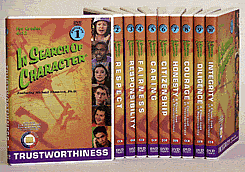

For more information about individual videos in this series, click on the title below.
• Trustworthiness
• Respect
• Responsibility
• Fairness
• Caring
• Citizenship
• Honesty
• Courage
• Diligence
• Integrity
• Respect
• Responsibility
• Fairness
• Caring
• Citizenship
• Honesty
• Courage
• Diligence
• Integrity
If your school or organization does not have these videos, you can purchase them from Live Wire Media, or request them from your local library.

Subscribe to our almost
Monthly Newsletter
Monthly Newsletter
Get breaking news and developments in character education and helpful tips and ideas that you can use with your own character education program.
View this month’s newsletter.
View this month’s newsletter.
