
No products in the cart.
This material is from the teaching guide
for the video “Saying No to Alcohol & Other Drugs“
in the 12-part DVD series Big Changes, Big Choices.
HOW TO SAY NO
Saying “no” to your friends can be very hard sometimes. You may be afraid of what they’ll think of you if you don’t go along with them. Here is a good way to say “no” and still be cool.
1. Say what the problem is (that’s mean, or, that’s illegal, etc.).
2. Say what the consequences are.
3. Suggest something to do instead.
4. If your friends insist on doing it anyway, leave. But leave the door open for them to change their minds and join you.
Sometimes you can make it easier on yourself by preparing in advance for a possible pressure situation. Here are some things you can do ahead of time.
• Think ahead and try to anticipate possible problems.
• Decide in advance what you intend to do.
• Think of some good ways to handle the situation if it arises, or some good ways to avoid the situation altogether.
 |
To find additional teaching guides on this and related topics for K-12, click here.
|
 |
DISCUSSION QUESTIONS
If you are using the video, ask the first two questions before viewing.
1. Agree or disagree: It’s better to go along with the crowd than to make your own choices. Why do you agree or disagree?
2. What is peer pressure? What does it have to do with making choices?
3. In what ways has peer pressure changed as you’ve gotten older?
4. Do you think peer pressure sometimes affects the way you or your friends make choices? In what way?
5. One boy in the video makes the point that peer pressure is nothing unless you fall into it, and you can choose not to do that. Do you agree with him? Why, or why not?
6. How do you decide whether or not it’s okay to go along with the crowd. When is it okay? When isn’t it okay?
This material is from the teaching guide
for the video “Saying No to Alcohol & Other Drugs“
in the 12-part DVD series Big Changes, Big Choices.

7. How does it make you feel when you do something that you felt you shouldn’t?
8. What makes it hard to say “no” to a friend?
 9. What are the benefits of knowing how to say “no?”
10. One boy in the video said that when you’re under the influence of alcohol, the alcohol starts doing your thinking for you. What did he mean by that? Do you agree? Why, or why not?
11. A girl in the video said that alcohol makes you say and do things you wouldn’t if you were sober. Do you think that’s true? If it is true, what’s wrong with it? Have you ever seen that happen to anyone?
12. A boy in the video said that when you’re under the influence of alcohol, you’re a hazard to yourself and others. What did he mean by that? Do you agree? Have you ever known anyone to get hurt, or to hurt someone else, while intoxicated?
13. Do you think that movies and television make alcohol use look attractive or unattractive? Does that influence you in any way? Do you agree with the way they portray it? What changes would you make?
14. Do you know anybody who has ever benefited from smoking, drinking alcohol, or using other drugs?
15. Do you know anybody who has been harmed by smoking, drinking alcohol, or using other drugs?
16. Does anything scare you about using alcohol or other drugs? What? Why?
17. The kids in the video suggest that pressure to do something is a lot easier to cope with if you decide in advance what you are going to do. What did they mean by that? Do you agree? Can you think of some examples?
18. What was most meaningful to you in this video? Why?
(If you wish to copy or use any material from this website, please click here for Terms of Use.)
 Other teaching guides in this series:
1. People often give themselves excuses when they’re about to do something they know they probably shouldn’t. Here is a list of commonly used excuses. Have the class analyze each one and determine what’s wrong with it. Then, ask them to think of other excuses that aren’t in this list, and analyze those, as well
—”Just one (or, a little won’t hurt).”
— “I can control myself, so this once won’t matter.”
— “Everybody’s doing it.”
— “I don’t want to be left out.”
— “I deserve this.”
— “I feel stressed out. This’ll help me relax.”
— “If I don’t do this, they’ll think I’m a . . . ”
— “If I don’t do this, they might not like me.”
— “If I don’t do this, they might get mad at me.”
— “I’m too young for this to hurt me.”
2. Excuses are things we say to ourselves to get out of saying “no.” What are some good things we can say to ourselves that will help us say “no” when we want to. Make a list and hang it on the wall as a constant reminder.
3. Make up several hypothetical situations and have the kids do role plays in which they practice the saying “no” method from the top of this column. Here are a few ideas to start with.
— Your friends want you to lie to your parents about where you’re really going, because if they knew the truth they wouldn’t let you go.
— Several of your friends are organizing a system for cheating on a big test, and they want you to be a part of it.
(If you wish to copy or use any material from this website, please click here for Terms of Use.)
This material is from the teaching guide
for the video “Saying No to Alcohol & Other Drugs“
in the 12-part DVD series Big Changes, Big Choices.
WRITING ASSIGNMENTS
1. Write about a time when you had to resist strong peer pressure to do something you didn’t want to do. How did it happen? How did it make you feel? Did you change anything or make any decisions based on that experience? What did you learn from it?
2. Write about someone you know who has gotten involved with alcohol or other drugs. How did it happen? How did it make you feel? Did you change anything or make any decisions based on that experience? What did you learn from it?
3. Write about the kinds of peer pressures that exist in your school or community. How do you feel about them? What could be done to reduce them or make them go away? What could you personally do to help improve the situation?
4. The kids in the video make the point that pressure to do something is easier to cope with if you decide in advance what you will or won’t do. Write about a time when deciding in advance helped you, or would have helped you, deal with a tough situation.
5. Imagine that some day you will have children. Write a letter of advice for them to read when they reach the age you are right now. Tell them what you think about alcohol, tobacco, and other drugs, and how you hope they will deal with these things in their own lives.
“Saying No
to Alcohol & Other Drugs”
The Video
to Alcohol & Other Drugs”
The Video
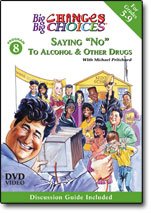
This video helps young adolescents:
• Look critically at the kinds of negative peer pressures they are under at this age.
• Recognize some of the ways in which they internalize peer pressure.
• Understand the harmful consequences of alcohol and other drug use.
• See how innocent actions can often lead to serious consequences.
• Learn some ways to resist negative peer pressure
“Big Changes, Big Choices”
the 12-part series
the 12-part series


In Big Changes, Big Choices comedian/teen counselor Michael Pritchard helps young adolescents discover that they have the power and the responsibility to make the right choices for themselves. more. . .
For more information about individual videos in this 12-part series, click on the title below.
• The Three Rs of Growing Up
• You and Your Values
• Enhancing Self-Esteem
• Setting & Achieving Goals
• Dealing With Pressures
• Handling Emotions
• Preventing Conflicts & Violence
• Saying No to Alcohol & Other Drugs
• Speaking of Sex
• Friendship
• Getting Along With Parents
• Respecting Others
If your school or organization does not have these videos, you can purchase them from Live Wire Media, or request them from your local library.
Subscribe to our almost
Monthly Newsletter
Get breaking news and developments in character education and helpful tips and ideas that you can use with your own character education program.
View this month’s newsletter.
