
No products in the cart.
This material is from the teaching guide
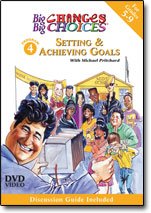
for the video “Setting & Achieving Goals“
in the 12-part DVD series Big Changes, Big Choices.
HOW TO SET GOALS
1. Define the goal.*
2. Outline the steps needed to achieve it.
3. Consider possible blocks and ways of dealing with them.
4. Set deadlines.
*Not every wish can be a goal. For instance, you may wish you could live and stay young forever, but since there’s nothing you can do to make that happen, it could never be considered a goal.
In order for something to be a goal:
• It has to be important to you, personally.
• It has to be within your power to make it happen through your own actions.
• It has to be something you have a reasonable chance of achieving.
• It must be clearly defined and have a specific plan of action.
 |
To find additional teaching guides on this and related topics for K-12, click here. |
 |
DISCUSSION QUESTIONS
If you are using the video, ask the first two questions before viewing.
1. Do you ever set goals for yourself? What are some goals you have right now (short term and long-term)?
2. Agree or disagree: It’s better to set lower goals than to risk failure by setting higher ones.
3. In the video, Mike Pritchard told a story about a guy sitting in a Hollywood coffee shop waiting to be discovered. What was the point of that story?
4. What’s the difference between a wish and a goal?
5. How do you decide what your goals are?
 6. Have you ever set a goal that was unrealistic? What happened? What did you learn from that?
7. Is it ever okay to take risks? What kinds of risks are okay? What kinds of risks are not okay?
8. Have you ever gone out on a limb and risked failure in order to achieve a bigger goal? (describe) Are you glad you took that risk?
This material is from the teaching guide
for the video “Setting & Achieving Goals“
in the 12-part DVD series Big Changes, Big Choices.

9. Has there been a time when you turned a failure into a success? (describe) What did you learn from that?
10. What’s the difference between failing and being a failure?
11. If you don’t accomplish all your goals does that make you a failure?
12. What are some good ways to deal with disappointments?
13. What is your personal definition of success?
14. Is it a good idea to set goals? Why, what do goals do for you?
15. What was most meaningful to you in this video? Why?
(If you wish to copy or use any material from this website, please click here for Terms of Use.)
 Other teaching guides in this series:
1. Practice some goal setting exercises. In each hypothetical case have the class go through the four step goal-setting process given at the top of this column.
Goal #1: Help a new kid in school feel included.
Goal #2: Get a good summer job.
Goal #3: Stop violence on the school grounds.
Goal #4: Earn enough money to buy a new bicycle.
Goal #5: Raise money to buy a new computer for the school library.
2. Have the class set some group goals. For instance, they could decide they want to achieve a certain average score on an exam. To accomplish this they might set up study groups so they can create structured study time and help each other. Or, perhaps, they will set goals for personal interaction that include standards of respectful behavior and rules for dealing with conflicts. Decide on a reward for achieving these goals, such as a picnic or some other fun payoff.
3. Have everybody in the class declare two short term goals that can be accomplished during the semester. Have them present their goals to the class, including their plans, their deadlines, and why these goals are important to them. Then, have them track their progress giving periodic progress reports to the whole class. Set up some kind of a reward for people who achieve their goals.
(If you wish to copy or use any material from this website, please click here for Terms of Use.)
This material is from the teaching guide
for the video “Setting & Achieving Goals“
in the 12-part DVD series Big Changes, Big Choices.
WRITING ASSIGNMENTS
1. If you could become anything you wanted, or accomplish anything you wanted in life, what would it be? What can you do to make that happen? Are you doing it? (If not, why not?)
2. Think of three things you’d like to accomplish in the next several months. These must be things that are truly important to you and within your power to accomplish. For each one, describe in detail what you will need to do in order to succeed and lay out a plan for doing it (including deadlines). Now that you have set three goals, try carrying out your plans.
3. Write about a time when you succeeded at something because you made it a goal and committed to it.
– Describe what happened.
– How did that make you feel?
– What did you learn from that experience?
4. Sometimes, despite our best plans and efforts, we fail anyway. Write about a time when you tried to accomplish something but came up short.
– Describe what happened.
– How did you deal with it?
– What did you learn from it?
– Did anything positive come out of it?
5. Imagine that some day you will have children. Write a letter of advice for them to read when they reach the age you are right now. Tell them about the goals you had at this age, and what those goals did for you. Tell them about taking risks – what kinds of risks are good to take and what kind aren’t. And tell them how to deal with failure and disappointment so they won’t be discouraged when things don’t work out the way they want.
This material is from the teaching guide
for the video “Setting & Achieving Goals“
in the 12-part DVD series Big Changes, Big Choices.
“Setting & Achieving Goals”
The Video
The Video
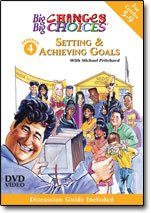
This video helps young adolescents:
• Realize the benefits of setting goals and committing to them.
• Develop a willingness to risk failure in order to pursue higher goals.
• Adopt an attitude of learning from failures and disappointments.
• Learn some techniques for goal setting.
“Big Changes, Big Choices”
the 12-part series
the 12-part series


In Big Changes, Big Choices comedian/teen counselor Michael Pritchard helps young adolescents discover that they have the power and the responsibility to make the right choices for themselves. more. . .
For more information about individual videos in this 12-part series, click on the title below.
• The Three Rs of Growing Up
• You and Your Values
• Enhancing Self-Esteem
• Setting & Achieving Goals
• Dealing With Pressures
• Handling Emotions
• Preventing Conflicts & Violence
• Saying No to Alcohol & Other Drugs
• Speaking of Sex
• Friendship
• Getting Along With Parents
• Respecting Others
If your school or organization does not have these videos, you can purchase them from Live Wire Media, or request them from your local library.
Subscribe to our almost
Monthly Newsletter
Get breaking news and developments in character education and helpful tips and ideas that you can use with your own character education program.
View this month’s newsletter.
