
No products in the cart.
This material is from the teaching guide
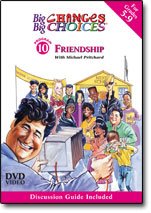
for the video “Friendship“
in the 12-part DVD series Big Changes, Big Choices.
HOW TO BE
A GOOD FRIEND
To have good friends you must be a good friend. Here are some of the ways good friends treat each other:
• Good friends listen to each other.
• Good friends don’t put each other down or hurt each other’s feelings.
• Good friends try to understand each other’s feelings and moods.
• Good friends help each other solve problems.
• Good friends give each other compliments.
• Good friends can disagree without hurting each other.
• Good friends are dependable.
• Good friends respect each other.
• Good friends are trustworthy.
• Good friends give each other room to change.
 |
To find additional teaching guides on Friendship and related topics for K-12, click here. |
 |
DISCUSSION QUESTIONS
If you are using the video, ask the first two questions before viewing.
1. What qualities do you look for in a friend?
2. Are friends more important to you now than they were in elementary school? Why?
3. There’s an old saying that goes “in order to have good friends you have to be a good friend.” What does that mean. Do you think it’s true?
4. What’s the difference between a friend and an acquaintance?
5. One boy in the video said that a true friend is somebody who knows everything about you and still likes you. What do you think that means?
6. How do you tell the difference between true friends and false friends?
7. What is a “best friend?” Is it possible to have more than one “best friend” at the same time?
8. In what ways does friendship change as you get older?
 9. The kids in the video talked about making space for their friends to go through changes. How do you do that? Is it always possible, or are some friendships destined to end?
10. Is there a difference between popularity and friendship? Can you be popular and not be a good friend? What is more important, being popular, or being a good friend?
11. Do you think there’s something wrong with you if you aren’t part of the popular set?
12. One girl in the video said that popular groups are sort of a whole big group of false friends. What did she mean by that? Do you think it’s true?
This material is from the teaching guide
for the video “Friendship“
in the 12-part DVD series Big Changes, Big Choices.

13. Describe the groups or cliques that people you know associate with. Are the relationships within these groups real friendships? What’s the difference between friendship and group membership?
14. The kids in the video said that cliques cut them off from people. Is that true in your experience?
15. What do you do if you want a person you have just met to become a part of your group, but the others don’t want to have anything to do with this new person?
16. Have you ever been excluded from a group? What happened? How did you feel? What should we learn from that?
17. Are there kids here at school who get constantly excluded? How do you think that makes them feel? Is there anything you could do about it?
18. Are there any racial or ethnic barriers to friendship at your school? How do you feel about that?
19. What are the benefits of having friends who are different from us?
20. What was most meaningful to you in this video.
(If you wish to copy or use any material from this website, please click here for Terms of Use.)
 Other teaching guides in this series:
1. When you see someone you think you’d like to become friends with, what are some good ways to initiate things? Brainstorm this and make a list.
2. Brainstorm ways to be a good friend. (See “How To Be A Good Friend,” at the top of this column.)
3. Let’s see how you would handle some sticky situations that can happen in friendships. For each situation given below, answer these questions:
•How would this make you feel?
•What is a positive way to deal with it?
•What is a harmful way to deal with it?
a. Your friend starts acting in ways that you think are wrong (drugs, stealing, being rude, etc.).
b. You find out your friend has been telling stories about you that aren’t true.
c. Your friend keeps saying or doing something that hurts your feelings.
d. Your friend invites you to go swimming, but calls back an hour later to cancel. You find out your friend went swimming with someone else.
e. You and your friend both want to run for the same class office.
g. You and your best friend have romantic feelings toward the same person.
h. Two friends of yours are at odds with each other. They demand that you choose between them. You don’t want to lose either of them.
i. Your friend wants to spend more time with you than you want to spend with him or her. You like this person very much, but you want more freedom to see other people, too.
j. Your friend is on the brink of failing a class and begs you to help him/her cheat on the final exam.
(If you wish to copy or use any material from this website, please click here for Terms of Use.)
This material is from the teaching guide
for the video “Friendship“
in the 12-part DVD series Big Changes, Big Choices.
WRITING ASSIGNMENTS
1. Write about the best friendship you’ve ever had. What made (or makes) it so special? Describe your friend. What are the qualities that you appreciate most about this person?
2. Imagine that some day you will have a child. Write a letter for that child to read when he or she reaches the age you are right now. Tell the child about the different kinds of friendships (good and bad) you had at this age, and the important things you’ve learned about friendship. Offer advice on how he/she can have good friendships at this age.
3. Write about a time when you really felt hurt by a friend. What happened? How did you handle it? Did you tell him or her how you felt? What could you have done differently? What have you learned from this experience?
4. Have you ever been jealous of a friend? What happened? How did you handle it? How could you have handled it better? Has a friend of yours ever been jealous of you? What happened? What have you learned from either of these experiences?
5. Have you and a friend ever drifted apart? What happened? How do you feel about it? How do you deal with that loss? Is there anything you could (or should) do to get back together?
6. Write about a time when a friend really helped you with something – really came through for you when you needed him or her. How did that make you feel? Did you tell him/her?
7. Watch a television program and write about one of the characters. Is that person a good friend to any of the other characters? Explain. Would you like to have this character for a friend? Why, or why not?
“Friendship”
The Video
The Video
This video teaches young adolescents:
• To recognize what makes a good friendship.
• That it is normal for friendships to change as we grow up.
• How to maintain good friendships through the tumultuous changes of adolescence.
• That it’s good to be open to friendships with people who are different from us.
“Big Changes, Big Choices”
the 12-part series
the 12-part series


In Big Changes, Big Choices comedian/teen counselor Michael Pritchard helps young adolescents discover that they have the power and the responsibility to make the right choices for themselves. more. . .
For more information about individual videos in this 12-part series, click on the title below.
• The Three Rs of Growing Up
• You and Your Values
• Enhancing Self-Esteem
• Setting & Achieving Goals
• Dealing With Pressures
• Handling Emotions
• Preventing Conflicts & Violence
• Saying No to Alcohol & Other Drugs
• Speaking of Sex
• Friendship
• Getting Along With Parents
• Respecting Others
If your school or organization does not have these videos, you can purchase them from Live Wire Media, or request them from your local library.
Subscribe to our almost
Monthly Newsletter
Get breaking news and developments in character education and helpful tips and ideas that you can use with your own character education program.
